Just Copy Me – Building Metacognative Thinkers through Explicit Modelling in Maths.
If you have ever been to a dance class, you will know that you learn a dance routine by watching the instructor dancing a few moves and then everyone tries to copy along with them. After a few goes through, most people can make an attempt at the steps, and we would say we have mastered that routine.
For a long time, much of teaching was structured a bit like a dance class. The teacher did something and then the student copied. In fact, I am old enough that many of my lessons at school were comprised solely of ‘dictation’, where the teacher read aloud from their teacher’s notes and we copied down what was said, word for word. This was then supposed to have imparted enough information to have learnt the topic.
Luckily research has now shown that merely copying information into a book isn’t going to properly embed that knowledge in a way that it can sensibly be used again when needed. In maths, in particular, which requires a set of procedural skills to be learnt alongside factual knowledge, copying information down all lesson isn’t going to help students very much at all. That isn’t to say that nothing needs to be written down, but notes need to be used carefully with a clear purpose in mind.
Historically at Talbot Heath every student had two maths books, one for notes and one for class work. The notes book was sometimes a work of art as students drew beautiful titles and diagrams, with colour coded headings and pastel highlighting. Indeed, before the internet revolutionised how we could find out information, those beautiful maths notebooks were the only source of revision material for students to refer to; if they wanted to look up how to do a topic they would use the examples in their notes book. However, that isn’t the case anymore, so with the new leadership of the maths department we were keen to take the notebooks in a new direction.
One of the main reasons why maths exists, and for many mathematicians their sole reason for studying the subject, is using it to solve problems. The KS3 and KS4 school maths curriculums have problem-solving as a thread linking all topics together. Therefore, the purpose of the examples we show students now is to give students scaffolded guidance about how a particular problem was solved, so that they can use that skill to solve another problem, even if on the surface the problems are not the same. Worked examples, carefully explained, give students the springboard to go and try questions themselves.
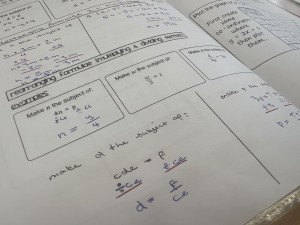
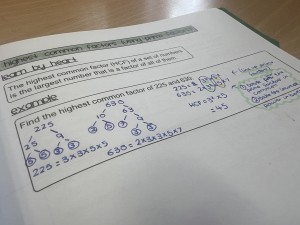
With this in mind, we introduced printed Maths Notes Booklets, where the factual information is pre-printed but the written maths, the thinking part, is missing. Instead gaps in worked examples are provided ready to be filled in by the student. This means that when meeting a new topic students can quickly get down to writing an example, step-by-step with guidance, often also annotating thinking steps along the way. It keeps the students focusing on what really matters, the maths, and not what their notes look like. The notes booklets have plenty of space around the pre-printed examples so that extra examples can be added and adapted to a specific group.
Booklets also provide consistency across all teachers in the department, and they save on planning time, after the initial creation stage. The presence of an empty example in a student’s notes also means that student is more obviously aware that they have missed a lesson and so can catch up. Another key benefit is for students with SEND, especially those for whom writing is difficult, since the clear examples allow them to focus on the skill being taught. The biggest win, however, has been the freeing up of lesson time to just do maths, whether that is in retrieval starter tasks, mini-whiteboard work or independent practice.
Feedback from students is that they like the layout and structure of the booklets and we feel that, so far, their introduction has had the desired improvement for practising more maths in lessons. Students are not just copying, but are actively thinking, and this will, we hope, have a positive effect on learning and results.
Julie Harris
Head of A Level Maths